Castling in Chess: Rules and How to Castle
Castling is the only move in chess where two pieces move at once. The king steps two squares toward a rook, and that rook jumps over to the square right next to the king. In one move it tucks your king behind its pawns and brings a rook into the game.
How to Castle, Step by Step
| Castling | White king | White rook | Black king | Black rook | Notation |
|---|---|---|---|---|---|
| Kingside (short) | e1 → g1 | h1 → f1 | e8 → g8 | h8 → f8 | O-O |
| Queenside (long) | e1 → c1 | a1 → d1 | e8 → c8 | a8 → d8 | O-O-O |
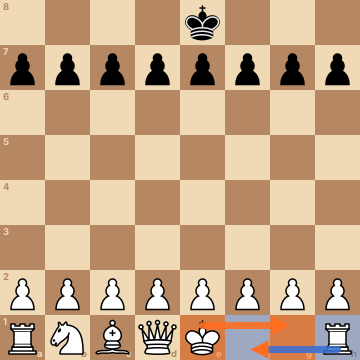
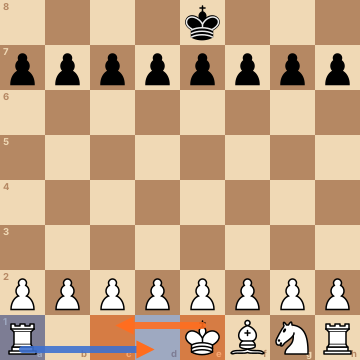
On a real board, move the king first, then the rook, with one hand.
The 5 Castling Rules
You can castle only when all five are true:
- Your king has not moved yet in this game.
- The rook you castle with has not moved yet.
- Every square between the king and that rook is empty.
- Your king is not in check right now.
- The king does not cross or land on a square attacked by an enemy piece.
Rule 5 is about the king only. The rook may be attacked, and in queenside castling the rook may pass over an attacked square (b1 or b8).
When You Can't Castle
- The king has moved, even if it moved back to its square. That right is gone for the rest of the game.
- That rook has moved. You can still castle on the other side if the king and the other rook haven't moved.
- A piece is in the way, yours or your opponent's.
- You are in check. Get out of check first; you can castle on a later move if the king never moved.
- The king would cross or land on an attacked square, which is why you can't castle through check.
Kingside or Queenside Castling?
Kingside castling is faster: only the knight and bishop need to move out of the way. Queenside castling needs three pieces gone (knight, bishop and queen), and the king ends one square further from the corner, so players often follow up with the king to b1 or b8.
In return, queenside castling puts the rook straight onto the d-file, which is why it is popular in sharp games where both players attack.
Common Castling Mistakes
- Touching the rook first. In tournaments, you castle by moving the king first. Under touch-move rules, touching the rook first means you must move the rook, and you lose the castle on that move.
- Castling too late, leaving the king in the middle while the position opens up.
- Thinking an earlier check stops castling. It doesn't, as long as the king never moved.
- Castling with a rook that moved and came back. Once a rook has moved, it can never castle.
Practice Castling on a Free Board
On Chess Pass and Play, tap your king. When castling is legal, the move hints show the square two steps to the side; tap it and the rook moves over by itself. If that square doesn't light up, one of the five rules is blocking it.
Two players can practice on one device, free and offline. Next, learn the pawn rules, including en passant and promotion.
Castling FAQ
No. If your king is in check, you must get out of check another way. You can castle on a later move if your king and that rook haven't moved.
No. The king can't cross a square attacked by an enemy piece, or land on one. The rook may cross an attacked square.
Yes. Only the king's squares matter: the king can't be in check, cross an attacked square or land on one.
Yes, as long as the king never moved. Blocking the check or capturing the checking piece keeps your right to castle.
No. Castling moves the king, so after you castle once you can't castle again.
No. Castling is only between the king and one of its rooks.
One move. The king and the rook move together on the same turn.
More Chess Guides
Practice Castling With a Friend
Two players, one device, no sign-up. Move hints show when you can castle.